
leftBar
BHS Filtration
navigation:

Rotary Pressure Filter

General Description

The BHS-Rotary Pressure Filter is a continuously operating filter of pressure-tight design. This makes it ideal for processing volatile and hazardous products as well as for sterile processes.

Extensive subsequent treatment processes are possible, such as cake washing in one to five stages with or against the direction of flow, solids/liquid extraction, steaming, blow-out, intermediate suction, subsequent hot drying and many others. The BHS-Rotary Pressure Filter works on the principle of cake filtration and is designed for the following operating parameters:

Criteria Download PDF Brochure PDF
  • Pressure differences up to 6 bar
  • Cake thickness up to 185 mm
  • Operating temperatures up to 160°C
  • Filtration capacity range 200 to 50 000 l/m²h
  • Solids content from 0.5 % by weight
  • Main grain size distribution 5 to 200 µm
rotary

Technical Description

Filtration
The filter drum rotates at infinitely variable speed in a pressure resistant housing. The annular segment between filter drum and housing is sealed at the side by stuffing boxes or air-seal chambers. Radially, sepa-rating elements divide the housing into pressure-tight chambers. The drum surface is made up of filter cells connected to the control heads by outlet pipes.

Operating Principle


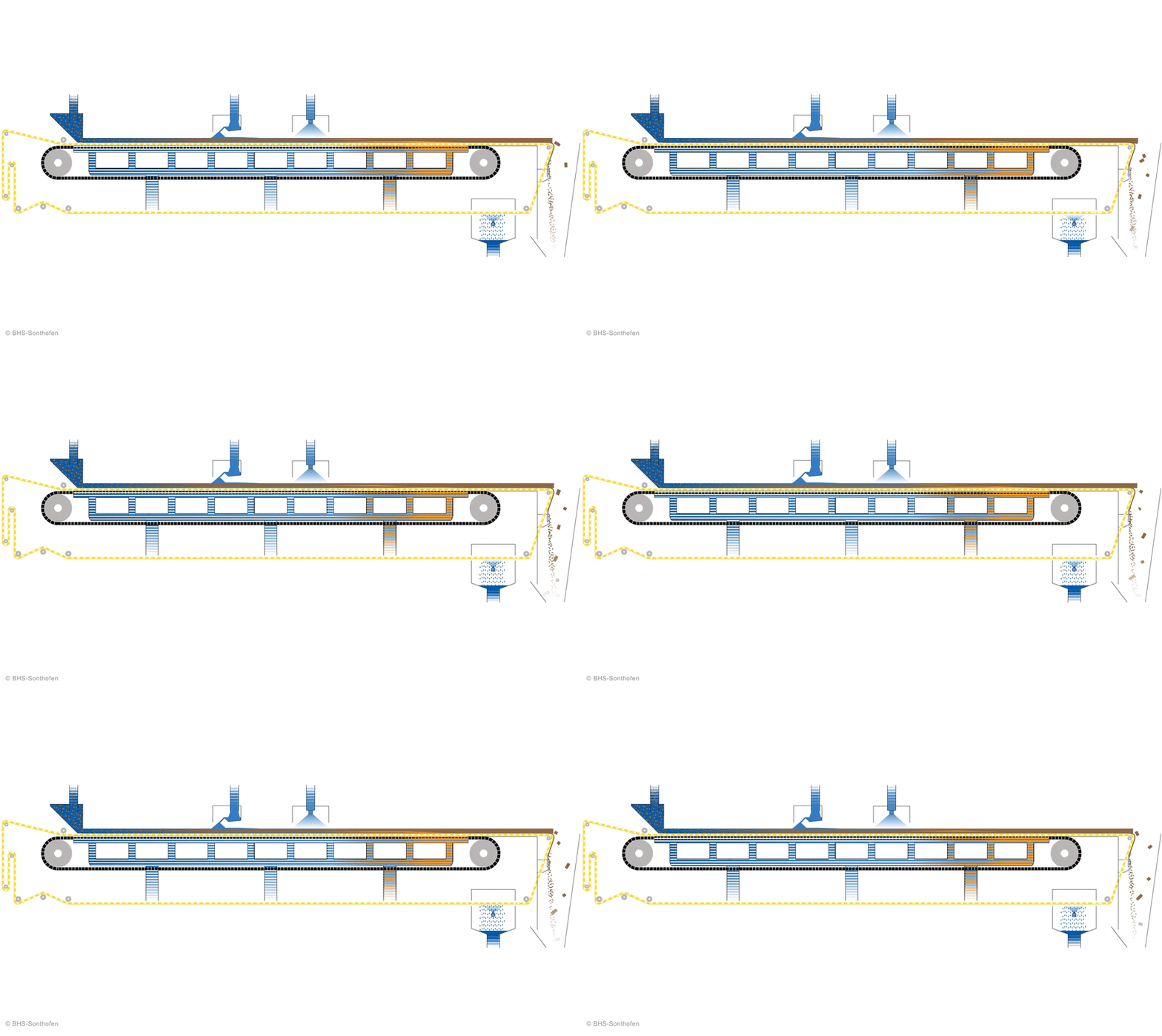
The suspension being filtered is continuously delivered under constant pressure to the separating zone of the BHS-Rotary Pressure Filter. A filter cake builds in the filter cells of the rotating drum and passes into follow-on chambers for further treatment. The filter cake is removed in a non-pressurised zone of the filter either by an automatic, adjustable mechanical scraper and/or by a specifically targeted back-blast of air.


Criteria: The BHS-Rotary Pressure Filter can be used to good effect where the following criteria need to be met on the process side:

Cake discharge
  • Continuous operation
  • Several consecutive work stages
  • Closed, gas-tight production
  • Workplace hygiene and safety
  • Fully automatic operation

Back to top

Applications

Dyes and pigments

Most dyes and pigments are extremely difficult to filter. High throughputs, good washing results and ex-cellent residual moisture levels are achieved in a continuous process under gentle pressure with thin cakes.

  • Phtalocyanine pigments
  • nacreous pigments
  • silicate pigments
  • aniline dyes
  • anthraquinone dyes

Bulk and final pharmaceutical products

In general, these products require good washing and dewatering in fully contained systems. The filters are designed to satisfy GMP requirements.

  • Fully synthetic and semi-synthetic antibiotics
  • antibiotic salts
  • herbal agents
  • extracts

Plastics

Fine and coarse-particle polymers and crystals can be washed and dewatered with optimum results. High-performance filters are capable of achieving throughput rates as high as 100 t/h solids.

  • Polyolefins
  • aromatic acids
  • acrylic resins
  • melamine resins

Agricultural, speciality and fine chemicals

The rotary pressure filter meets the stringent requirements for workplace safety and containment of toxic products.

  • Insecticides
  • fungicides
  • molluscides
  • herbicides

Foodstuffs

Fragile substances undergo gentle treatment without crystal destruction and avoiding contact with air.

  • Edible fats
  • amino acids
  • stearins
  • synthetic proteins
  • lecithins
  • plant extracts
  • vitamins

Cellulose products

Even the most difficult-to-process products are filtered, washed and dewatered in the specified tem-perature range, without the problem of gel formation.

  • Methyl cellulose
  • CMC
  • cellulose derivatives
  • microcellulose and starch chemicals

Inorganic and organic chemicals

Many other products are also processed on rotary pressure filters. These include:

  • vulcanising additives
  • sodium hydrosulphite
  • carbonates
  • anthraquinone and derivatives
  • phenyls
  • amines
  • paraffins
  • urea adducts
  • raw materials for detergents

Back to top


Technical Data

   type Filter
area
in m2
Drum
diameter
in m
Dimensions
(WxHxL)
in m
Weight
appr.
kg
   T 0.12 0.50 1.0 x 0.9 x 1.6 900
   K3 0.54 0.75 2.0 x 1.9 x 1.8 3300
   K6 1.08 0.75 2.3 x 1.9 x 1.8 3700
   A6 1.44 1.00 2.5 x 2.1 x 2.2 5900
   A9 2.16 1.00 2.7 x 2.3 x 2.2 7300
   A12 2.88 1.00 3.3 x 2.4 x 2.5 8500
   B9 3.20 1.5   3.1 x 2.9 x 3.2 11500
   B12 4.32 1.5   3.7 x 3.0 x 3.2 14000
   B16 5.76 1.5   4.0 x 3.0 x 3.2 17500
   X16 6.7 1.8   4.2 x 3.2 x 3.6 21000
   C16 7.68 2.0   4.3 x 3.4 x 4.0 23500

Materials

  • Metallic materials in contact with the product:
    1.4541, 1.4571, 1.4539, 2.4602, etc.
  • Packings for housing and control head:
    hemp/PTFE, PTFE, PTFE/graphite, aramid etc.
  • Seals:
    EPDM, butyl rubber, PTFE
  • Filter fabric:
    textile filter cloths, e.g. in polypropylene, polyamide, polyester, special steel mesh or multilayer media

Back to Top

Related Articles

Back to top